
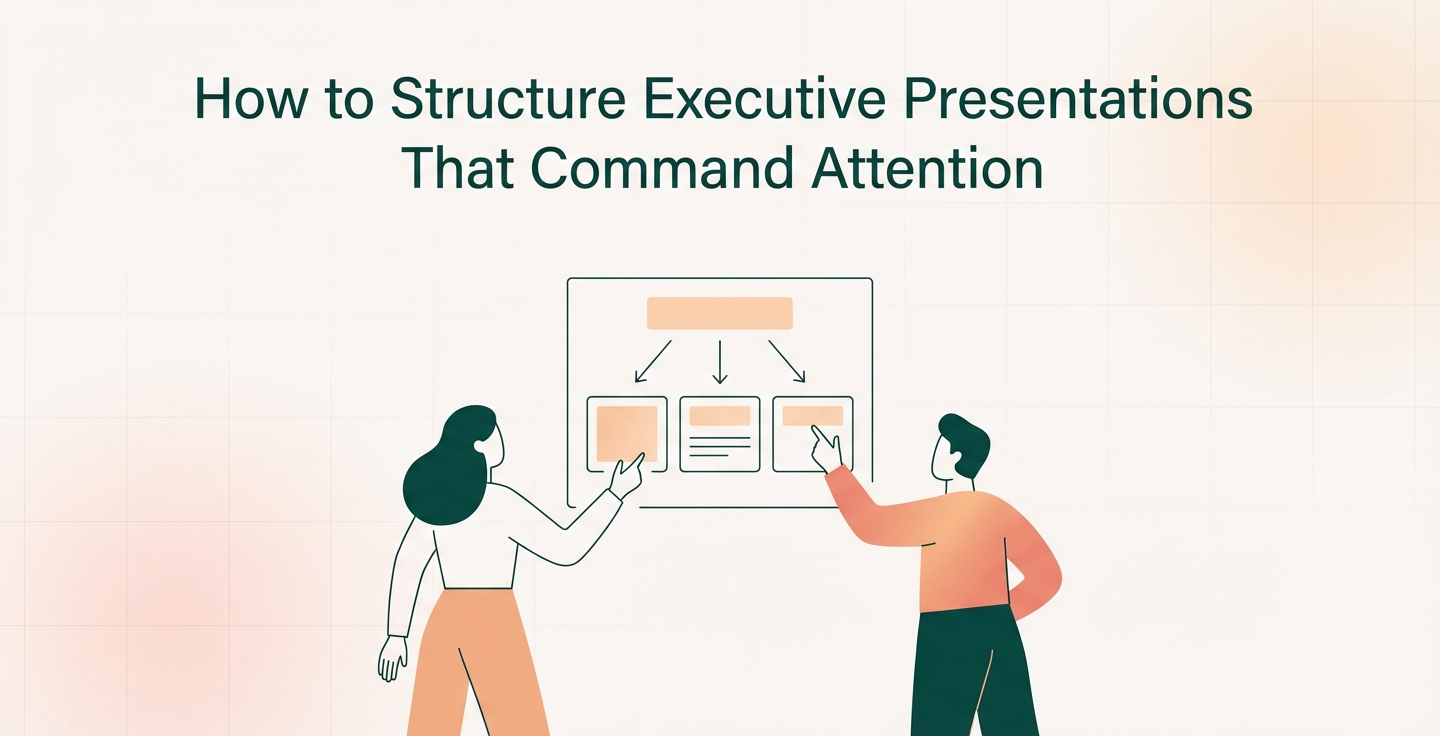
How to Structure Executive Presentations That Command Attention
Presenting to executives requires a fundamentally different approach than other presentation contexts. C-suite audiences operate under extreme time constraints, process information quickly, and make decisions based on strategic implications rather than tactical details.
The presentation structure that works for team meetings or client pitches often fails spectacularly in the boardroom. Executives don't have patience for lengthy build-ups, exhaustive backgrounds, or delayed insights. They want conclusions first, supporting evidence available on demand, and clear recommendations that enable immediate decision-making.
This guide reveals the structural frameworks that experienced consultants and corporate strategists use when presenting to executive audiences.
The Pyramid Principle: Start with the Answer
The Pyramid Principle, developed by Barbara Minto at McKinsey, revolutionized business communication by inverting traditional narrative structures. Instead of building toward a conclusion, you begin with it.
Why This Works for Executives
Executives make dozens of decisions daily. They've developed cognitive shortcuts that let them quickly assess whether information requires deep attention or can be delegated, deferred, or dismissed.
When you start with your conclusion, executives can immediately determine: "Is this relevant to strategic priorities?" If yes, they engage deeply. If no, they can redirect focus to more pressing matters without sitting through your entire presentation.
Starting with conclusions also respects executive time. If your presentation gets cut short—a common occurrence when urgent matters arise—you've already communicated the essential message.
Implementing the Pyramid Structure
Your opening slide after the title should state your primary conclusion, recommendation, or insight. Not the context. Not the methodology. The answer.
Example opening: "We recommend consolidating our three regional supply chains into a single centralized model, projected to reduce costs by 23% while improving delivery times by 40%."
This opening immediately tells executives what you're proposing and the magnitude of impact. They can now engage with why, how, and what's required—but they already know where you're going.
Following slides provide supporting evidence organized in logical groups: financial analysis, operational implications, implementation requirements, and risk mitigation. Each section supports elements of your opening recommendation.
The Executive Briefing Structure: Four Essential Components
Successful executive presentations typically include four distinct sections, presented in this specific order.
1. Situation and Recommendation (1-2 Slides)
Concisely state the current situation and your specific recommendation.
Situation: "Q4 customer acquisition costs increased 47% while conversion rates declined 12%, threatening our path to profitability."
Recommendation: "Implement account-based marketing for enterprise segment while optimizing digital channels for SMB segment, projected to reduce blended CAC by 31%."
This framing immediately establishes context and direction. Executives understand the problem's magnitude and your proposed solution before any detailed analysis.
2. Key Insights and Supporting Evidence (3-5 Slides)
Present the 3-4 most critical insights that support your recommendation. Each insight should be substantial enough to warrant its own slide.
Structure each insight slide with:
- Headline: The insight itself (not a topic label)
- Visualization: Data that proves the insight
- Implication: Why this matters strategically
Example headline: "Enterprise customers have 4.7x higher lifetime value but receive identical marketing treatment to SMBs"
This is an insight—a meaningful discovery that shapes strategic thinking. It's not "Customer Segmentation Analysis" (a topic label that communicates nothing).
The visualization might be a comparison chart showing LTV across segments. The implication: treating all customers identically misallocates resources and underinvests in the highest-value segment.
3. Implementation Approach (2-3 Slides)
Executives need to understand how your recommendation translates into action. Cover:
- Phases: Break implementation into logical stages with timeframes
- Resources Required: Budget, personnel, systems, partners
- Quick Wins: Early deliverables that build momentum and prove value
- Dependencies: Prerequisites, sequencing requirements, coordination needs
Avoid excessive tactical detail. You're outlining the approach, not project-managing implementation. If executives want deeper tactical breakdowns, that becomes follow-up work.
4. Risks and Mitigation (1-2 Slides)
Acknowledging risks demonstrates thorough thinking and builds credibility. Executives expect sophisticated analysis that considers what could go wrong.
Identify the 3-4 most significant risks and your mitigation strategies for each. Format this as:
Risk: "Competitor response could include price wars that erode margins."
Mitigation: "Differentiation strategy emphasizes non-price value drivers; maintain price flexibility reserve in budget; monitor competitor moves weekly for rapid response."
This shows you've thought critically about vulnerabilities and have response plans ready.
The "Pre-Read and Discussion" Hybrid Model
Many sophisticated organizations now use a hybrid approach that maximizes efficiency and depth.
The Pre-Read Document
Before the meeting, distribute a comprehensive document (typically 8-15 pages) containing all analysis, data, methodologies, and supporting details. This becomes required reading before the presentation meeting.
The pre-read should be a complete standalone document. Executives who read it thoroughly should understand your entire argument, evidence, and recommendation without attending the presentation.
The Presentation Becomes a Discussion
With everyone pre-read, your "presentation" transforms into a discussion. You begin with a 2-3 minute recap of core recommendations, then immediately open for questions, challenges, and strategic dialogue.
This approach works exceptionally well for complex topics requiring deep engagement. Instead of spending 30 minutes presenting what executives could read in 15 minutes, you spend 45 minutes in strategic dialogue that reaches better decisions.
Making Pre-Reads Work
Success requires discipline. The pre-read must be distributed far enough in advance (typically 48-72 hours) for busy executives to actually read it. You must hold the boundary—if participants haven't read it, reschedule rather than presenting content they should have read.
Include a one-page executive summary at the front of pre-read documents. Even executives who can't read the full document can process the summary and engage meaningfully.
Story Arcs That Work for Strategic Topics
While "start with the answer" is generally correct for executive presentations, certain contexts benefit from strategic narrative development.
The Tension-Resolution Arc
Begin by establishing meaningful tension: a challenge, threat, or opportunity that demands attention. Build that tension by quantifying implications and showing why it matters now. Then resolve the tension with your recommendation.
Example opening: "Our largest competitor just announced technology that makes our core product feature obsolete. Industry analysts project this could shift 35% market share within 18 months. But we've identified a response strategy that positions us not just to defend our position, but to leapfrog the competitive set entirely."
This arc works when you need to overcome complacency or resistance to change. The tension creates urgency that makes your recommendation feel necessary rather than optional.
The Opportunity Narrative
Begin by revealing an insight that most people haven't recognized—a market shift, customer behavior change, or competitive vulnerability. Establish why this insight creates a time-bound opportunity. Then present your recommendation as the way to capture that opportunity.
Example: "While everyone focuses on GenZ demographics, we've identified a surprisingly underserved segment: affluent millennials aged 35-42 with children. This segment is 3.2x more profitable than our current targets, actively looking for solutions we could provide, and being ignored by all major competitors."
This arc positions your recommendation as offensive rather than defensive, appealing to growth-oriented executives.
Slide-Level Design Principles for Executive Decks
Get Poesius for Free
Create professional presentations 5x faster than manual formatting
Get custom-designed slides built from the ground up, not templates
Start free with no credit card required
Headlines Are Insights, Not Topics
Every slide headline should communicate a complete thought—ideally the slide's main insight.
Weak: "Market Analysis"
Strong: "Market growth is accelerating in mid-tier cities while traditional metros plateau"
The strong headline is a complete, meaningful statement. An executive reading just the headlines should understand your complete argument.
One Main Point Per Slide
Resist the temptation to cram multiple messages onto slides. Each slide should communicate one primary idea supported by one primary visualization or evidence piece.
If you need to communicate three related insights, create three slides. This seems wasteful but dramatically improves comprehension and recall.
Data Visualizations That Tell Stories
Every chart in an executive presentation should tell a story visually, with minimal explanation required.
Use annotations, callouts, and highlighting to direct attention to the specific data points that support your narrative. Don't present a chart and make executives hunt for the relevant insight—show them exactly what to see.
Appendix for Deep Dives
Keep your main presentation tight—typically 10-15 slides for a 30-minute time slot. Move all supporting analysis, detailed methodologies, alternative scenarios, and comprehensive data into an appendix.
During Q&A, executives often want to go deeper on specific points. Having detailed appendix slides ready lets you address these questions rigorously without cluttering the main presentation.
Label appendix slides clearly and reference them in your main slides where appropriate: "Detailed methodology available in appendix slides 18-22."
Handling Executive Questions and Challenges
Executive Q&A requires different skills than presenting. Executives ask tough questions to test thinking, expose weak spots, and push for stronger recommendations.
The STAR Response Framework
Situation: Briefly restate the context relevant to the question Task: Clarify what needed to be determined or solved Analysis: Explain the analysis or reasoning that led to your conclusion Result: State the specific answer or recommendation
This framework ensures your answers are complete, logical, and credible without rambling.
Handling "I Disagree"
When an executive challenges your recommendation, resist defensive reactions. Instead:
Acknowledge: "I understand your concern about implementation complexity."
Clarify: "Is your primary concern the technical integration or the organizational change management?"
Address: "For the technical integration, we've built in a phased approach with..."
Sometimes disagreement stems from information gaps. Sometimes it reflects different strategic priorities or risk tolerances. Understanding the source of disagreement lets you address it productively.
The Power of "I Don't Know"
Credibility comes from knowing your limits. When asked a question you can't answer confidently, say so—then explain how you'd find out.
"I don't have our exact retention rates for that specific customer segment with me, but I can pull that analysis and send it this afternoon. Would that timing work?"
This response maintains credibility while committing to follow-through. Making up answers destroys trust.
Common Mistakes That Undermine Executive Presentations
Starting with Excessive Background
Many presenters spend the first 5-10 minutes on company history, market context, or methodology—information executives either already know or don't need.
Assume executive audiences have context. If specific background is truly necessary, provide it in a brief pre-read or as appendix material. Your presentation time is too valuable for extended setup.
Presenting Process Instead of Outcomes
Executives care about results and implications, not the process you followed to reach them.
Don't walk through your analytical journey step-by-step. Present the conclusions that journey produced, with evidence, and make your process available in the appendix for anyone interested.
Hedging and Qualification
Excessive hedging signals lack of confidence. Phrases like "we think maybe this could potentially" undermine credibility.
Be direct. If you're making a recommendation, own it. "We recommend X" is stronger than "We're thinking that X might be worth considering."
Acknowledge uncertainty where it genuinely exists, but don't inflate uncertainty to protect yourself from being wrong.
Lack of Clear Ask
Many presentations end ambiguously, leaving executives uncertain about what you need from them.
End every executive presentation with a clear, specific ask:
- "We're requesting approval to proceed with phase one, requiring $2.3M budget allocation."
- "We need your decision on the preferred approach so we can finalize vendor contracts by month-end."
- "We're seeking input on the three strategic options outlined to inform our detailed planning."
Make the next step obvious and actionable.
Frequently Asked Questions
How long should an executive presentation be?
Typically 15-30 minutes for the presentation itself, with additional time for Q&A. Executives have limited attention spans for presentations—they prefer discussion over passive listening. Aim for concise delivery that catalyzes meaningful dialogue.
Should I read slides verbatim or speak differently from what's shown?
Never read slides verbatim—it wastes everyone's time. Slides should be visually scannable quickly, while your verbal commentary adds nuance, context, and emphasis. The slide headline captures the main point; you elaborate on implications and supporting reasoning.
How do I handle interruptions from executives asking questions mid-presentation?
Welcome interruptions—they signal engagement. Answer questions directly, then either return to your planned flow or, if the questions have covered upcoming material, skip ahead. Flexibility is more important than rigid slide sequence.
What if I don't get to all my slides?
That's normal and fine. If executive discussion is productive, let it continue rather than rushing to cover remaining slides. Distribute your full deck afterward so executives can review any uncovered material.
How technical should I get with data and analysis?
Present data at the insight level—what the data reveals and why it matters. Keep methodological details in the appendix. If an executive wants deeper technical detail, they'll ask, and you can either address it verbally or point to appendix slides.
Related Resources
- Presentation Design Principles Every Professional Should Know
- How to Create Investor Pitch Decks That Get Funded
- Data Visualization Best Practices for Business Presentations
- Structuring Sales Presentations That Close Deals
- Top 10 AI Presentation Tools in 2026
Conclusion: Structure Drives Impact
The structure of your executive presentation matters as much as its content. Brilliant analysis poorly structured wastes executive time and fails to drive decisions. Adequate analysis optimally structured catalyzes action and alignment.
Start with answers, not questions. Lead with conclusions, not journeys. Provide evidence efficiently, acknowledge risks honestly, and end with clear asks. This approach respects executive constraints while maximizing decision quality and speed.
Master these structural principles, and you'll find executives engage more deeply, understand more completely, and act more decisively on your recommendations. That's the ultimate measure of presentation success: not applause, but action.
Get Poesius for Free
Create professional presentations 5x faster than manual formatting
Get custom-designed slides built from the ground up, not templates
Start free with no credit card required