
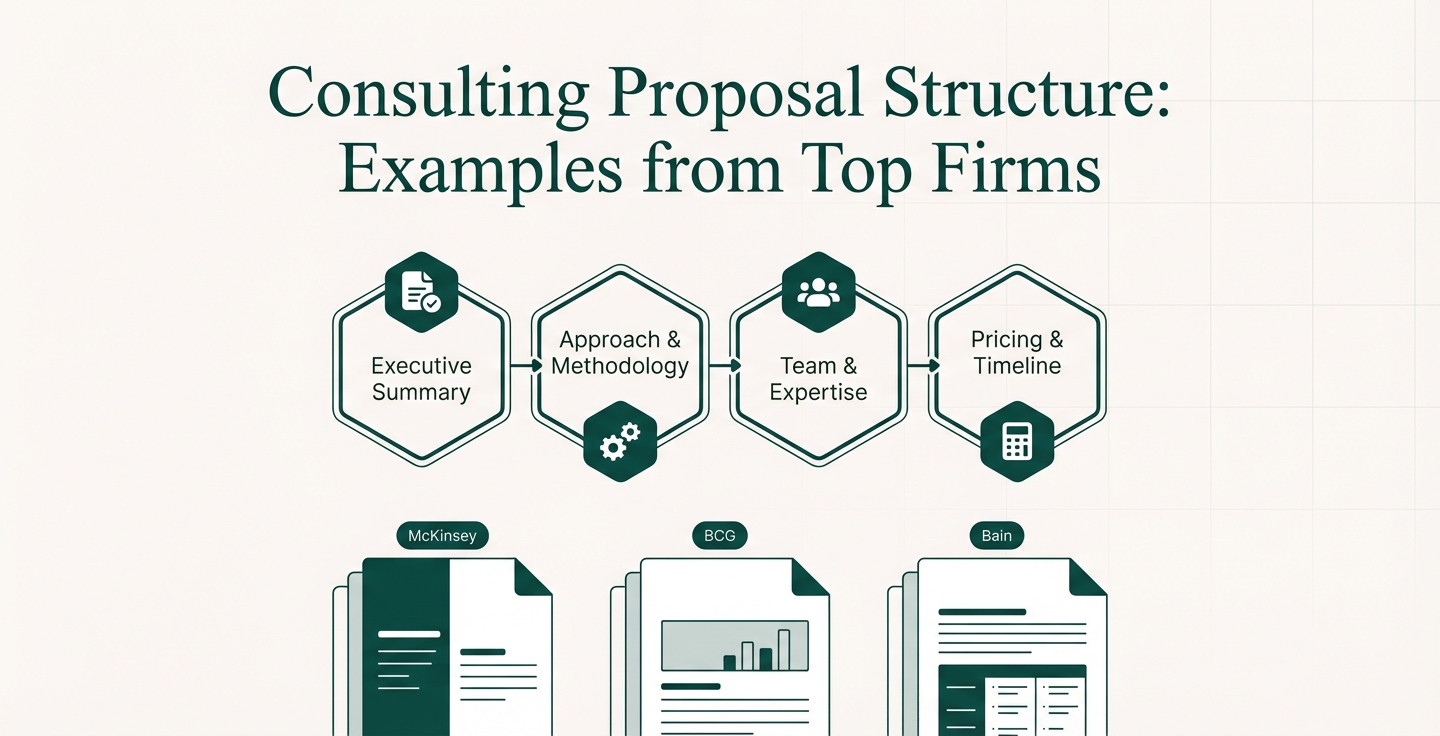
Consulting Proposal Structure: Examples from Top Firms
Consulting proposals are sales documents disguised as analytical frameworks. They must demonstrate understanding of the client's situation, showcase relevant expertise, propose clear approaches, and justify fees—all while building confidence that you're the right partner for this engagement.
Top consulting firms have refined proposal structures over decades of winning competitive bids. This guide reveals those structures, enabling you to create proposals that win engagements.
The Standard Consulting Proposal Architecture
Successful consulting proposals follow a proven structure that addresses decision-maker concerns in logical sequence.
Executive Summary (1-2 Pages)
The executive summary determines whether decision-makers read further. Write this last, after completing the full proposal, extracting the most compelling elements.
Components:
- Client's Situation: Demonstrate you understand their challenge (2-3 sentences)
- Our Understanding: Show you grasp the nuances others might miss (2-3 sentences)
- Proposed Approach: High-level methodology (3-4 sentences)
- Expected Outcomes: Specific, measurable deliverables (3-4 bullet points)
- Why Us: Unique qualifications for this specific engagement (2-3 sentences)
- Investment: Total fees and timeline (1 sentence)
Example Opening: "Your consumer goods division faces margin pressure from private label competition while attempting digital transformation. Many consultants would recommend generic digital strategies. We've identified that your challenge is operational—distribution costs are 340 basis points above category benchmarks due to legacy network design. Our 12-week diagnostic and redesign will reduce distribution costs by $18-24M annually while improving delivery times 15-20%."
This opening demonstrates specific understanding (340 bps cost premium), unique insight (operational not strategic problem), and quantified outcomes ($18-24M savings).
Situation Assessment (2-4 Pages)
Prove you've done preliminary analysis and understand their business better than competitors.
Market Context:
- Industry trends affecting the client
- Competitive dynamics creating pressure
- Regulatory or technological disruptions
Use specific data: "The grocery category saw private label share increase from 18% to 26% over 36 months, with acceleration in Q3-Q4 2025."
Client-Specific Context:
- Performance trends (from public data or prior conversations)
- Strategic initiatives underway
- Organizational capabilities and constraints
The Problem Definition: State the core issue you'll address, demonstrating sophistication beyond the RFP language.
"While the RFP frames this as a 'digital transformation,' our preliminary analysis suggests the underlying issue is operational inefficiency masked by revenue growth. As growth slows, cost structure becomes untenable. Digital enablement will help, but without addressing fundamental operational issues, digital investments deliver minimal ROI."
This reframing demonstrates strategic thinking that justifies consultant fees.
Our Proposed Approach (3-5 Pages)
Detail your methodology, differentiating from generic approaches competitors offer.
Phase Structure:
Phase 1: Diagnostic (Weeks 1-4)
- Detailed assessment approach
- Data to be collected and analyzed
- Interviews to be conducted (who, how many, focus areas)
- Analyses to be performed
- Phase 1 Deliverable: Diagnostic report with prioritized opportunities
Phase 2: Solution Design (Weeks 5-8)
- Design workshops and facilitation approach
- Prototyping and testing methodology
- Stakeholder validation process
- Phase 2 Deliverable: Detailed solution designs with business cases
Phase 3: Implementation Planning (Weeks 9-12)
- Implementation roadmap development
- Change management and communications planning
- Capability building and training approach
- Phase 3 Deliverable: Implementation playbook and execution plan
Methodological Differentiators:
Explain what you do differently that creates superior outcomes:
"Unlike traditional process mapping that documents current state, our 'Zero-Based Process Design' starts with customer requirements and designs ideal state workflows, then identifies gaps versus current state. This approach typically uncovers 20-30% more improvement opportunity than traditional approaches."
This explains why your methodology delivers better results, justifying premium fees.
Expected Outcomes and Value (2-3 Pages)
Quantify the value you'll create, making the investment decision obvious.
Deliverables: List every tangible output:
- Diagnostic report with opportunity sizing
- Solution designs (process flows, org structures, system requirements)
- Financial models showing implementation costs and benefits
- Implementation roadmap with 18-month plan
- Change management playbook
- Training materials
Business Impact: Quantify expected outcomes with ranges reflecting uncertainty:
Financial Impact:
- Cost reduction: $18-24M annually (15-20% of target cost base)
- Working capital improvement: $8-12M one-time (inventory and receivables optimization)
- Total Value: $26-36M Year 1
Operational Impact:
- Delivery time improvement: 15-20% reduction
- Order accuracy: 96% to 99%+ improvement
- Customer satisfaction: +12-18 points NPS improvement
Strategic Impact:
- Competitive positioning: Close 60% of cost gap to best-in-class
- Organizational capability: Build sustainable continuous improvement culture
- Scalability: Platform for future growth without proportional cost increase
ROI Calculation: "At project investment of $1.2M, financial benefits alone deliver 15-20x ROI in Year 1, with ongoing benefits in subsequent years."
This makes the economic decision straightforward.
Why Us / Relevant Experience (2-4 Pages)
Demonstrate you have the specific expertise this engagement requires.
Relevant Project Examples:
For each relevant past project (typically 3-5 examples):
Client: "[Industry] company with $2B revenue" (anonymized) Challenge: Concise problem description Our Approach: Key methodology highlights Outcomes: Quantified results achieved Relevance: Why this experience applies to their situation
Example: "We helped a $1.8B food & beverage manufacturer reduce distribution costs by $32M (22%) through network redesign and operational improvement. Like your situation, they had legacy distribution infrastructure designed for a different portfolio. The methodologies we'll use with you were refined on this engagement."
Team Qualifications:
Project Lead: [Name and title]
- Relevant expertise (10+ years supply chain consulting)
- Specific credentials (SCPro certification, former VP Operations at Fortune 500 CPG)
- Similar engagements led (12 distribution network optimizations, $400M+ in client value created)
Team Composition:
- 1 Partner (5% time, strategic guidance and quality assurance)
- 1 Project Lead (50% time, day-to-day leadership)
- 2 Consultants (100% time, analysis and design work)
- Client team members (part-time involvement)
This staffing model shows appropriate senior leverage without over-staffing.
Project Plan and Timeline (1-2 Pages)
Gantt Chart Format: Visual timeline showing:
- Phase durations
- Major milestones
- Deliverable dates
- Client decision points
- Resource allocation
Governance Structure:
- Weekly team working sessions
- Bi-weekly steering committee updates
- Monthly executive sponsor reviews
- Ad-hoc escalation process for issues
Client Commitments Required: Be explicit about what you need from the client:
- Executive sponsor time: 2 hours/week
- SME interviews: 25-30 people, 90 minutes each
- Data access: Systems, reports, historical analyses
- Workspace: On-site workspace for team
- Decision-making: 2-week turnaround on key decisions
Stating requirements upfront prevents scope issues later.
Investment and Terms (1-2 Pages)
Get Poesius for Free
Create professional presentations 5x faster than manual formatting
Get custom-designed slides built from the ground up, not templates
Start free with no credit card required
Fee Structure:
Professional Fees: $1,180,000
- Phase 1 Diagnostic: $320,000
- Phase 2 Solution Design: $480,000
- Phase 3 Implementation Planning: $380,000
Expenses: $45,000 (estimate)
- Travel and accommodation
- Software licenses and tools
- Printing and materials
Total Investment: $1,225,000
Payment Terms:
- 25% upon engagement signing
- 25% upon Phase 1 completion
- 25% upon Phase 2 completion
- 25% upon final deliverable acceptance
Commercial Terms:
- Fixed-fee engagement (no hourly billing surprises)
- Phase gates: Client can pause after each phase
- IP rights: Client owns all deliverables and work product
- Confidentiality: Standard mutual NDA
- Liability: Limited to fees paid (standard consulting T&Cs)
Fee Justification: "Investment represents approximately 5% of Year 1 expected value creation and 3.4% of ongoing annual value. Typical consulting projects deliver 8-12x ROI; we're projecting 15-20x based on opportunity sizing."
This framing makes the fee a value-based investment decision.
Proposal Variations by Engagement Type
Strategy Consulting Proposals
Emphasis:
- Market analysis depth
- Strategic frameworks (Porter's, MECE decompositions)
- Competitive intelligence
- Growth opportunities
Deliverables:
- Strategic options analysis
- Recommended strategy with supporting business case
- Implementation roadmap
Typical Duration: 8-16 weeks
Operations Consulting Proposals
Emphasis:
- Current state assessment rigor
- Quantified improvement opportunities
- Implementation feasibility
- Quick wins versus structural changes
Deliverables:
- Diagnostic report with root cause analysis
- Process designs and SOPs
- Implementation playbook
- Training materials
Typical Duration: 12-24 weeks
Technology Consulting Proposals
Emphasis:
- Technology landscape assessment
- Architecture and design
- Vendor selection criteria
- Implementation approach
Deliverables:
- Requirements documentation
- Solution architecture
- Vendor RFP materials
- Implementation roadmap
Typical Duration: 16-32 weeks (longer due to implementation)
Organizational Consulting Proposals
Emphasis:
- Organizational assessment
- Culture and change management
- Stakeholder analysis
- Leadership development
Deliverables:
- Organizational design options
- Change management strategy
- Communications plan
- Leadership coaching approach
Typical Duration: 12-20 weeks
Writing Techniques That Win Proposals
Demonstrate Insights, Not Just Understanding
Weak: "We understand you're facing competitive pressure."
Strong: "Private label competition grew 8 percentage points in 36 months—twice the industry average—suggesting your brand equity and shelf positioning need reexamination beyond the cost focus in the RFP."
The strong version shows you've analyzed their situation and have perspectives they don't.
Quantify Everything Possible
Replace qualitative claims with numbers:
- "Significant savings" → "$18-24M annually"
- "Faster delivery" → "15-20% reduction in cycle time"
- "Improved quality" → "Defect rate reduction from 3.2% to <1%"
Use Client's Language
Mirror terminology from the RFP and prior conversations. If they call it "digital enablement," don't rebrand it "digital transformation." Unnecessary rebranding signals you're not listening.
Show, Don't Tell, Credibility
Telling: "We're experts in supply chain optimization."
Showing: "Our team has led 47 distribution network optimizations across CPG, generating $830M in documented client value over the past 5 years. Three team members are former VP-level supply chain executives from Fortune 500 companies."
Specific numbers and credentials prove expertise; generic claims don't.
Common Proposal Mistakes
Over-Promising Outcomes
Aggressive projections that prove unrealistic destroy credibility. Provide ranges, show sensitivities, and be conservative. Better to exceed conservative projections than miss aggressive ones.
Boilerplate Approaches
Generic methodologies that could apply to anyone signal you haven't customized for this client. Every proposal should feel written specifically for them, because it should be.
Unclear Value Proposition
If the reader finishes your proposal unable to articulate "What will these consultants specifically do and what outcomes will that create?", you haven't been clear enough.
Weak Differentiation
Proposals that don't explain what you do differently or better give clients no reason to choose you over competitors. Your methodology section must clearly differentiate.
Vague Deliverables
"Strategic recommendations" isn't a deliverable. "Strategic options analysis with financial model showing ROI for each option, risk assessment, and recommended strategy with 18-month implementation roadmap" is a deliverable.
Tools for Creating Consulting Proposals
Poesius for Proposal Development
Poesius, built by ex-McKinsey consultants, enables the custom frameworks and sophisticated visualizations consulting proposals require. When presenting diagnostic approaches, MECE decompositions, or implementation roadmaps in proposals, Poesius's custom slide-by-slide design ensures your methodology is communicated with consulting-grade visual quality.
For proposals requiring Gantt charts, opportunity sizing frameworks, or value creation waterfalls, the platform builds each visualization specifically for your engagement rather than forcing content into generic templates.
Frequently Asked Questions
How long should a consulting proposal be?
Typically 15-25 pages for the main proposal, plus appendices with team CVs, case studies, and standard T&Cs. Executives read the executive summary and skim the rest; detailed reviewers examine everything.
Should I include pricing in the executive summary?
Yes—decision-makers want to know total investment upfront. Burying pricing signals discomfort with your fees.
How detailed should the methodology be?
Detailed enough to demonstrate expertise and differentiate from competitors, but not so detailed you're giving away IP. Focus on approach and frameworks, not execution specifics.
What if the client wants a time-and-materials proposal instead of fixed-fee?
Provide both options with clear tradeoffs. Fixed-fee shows confidence and provides budget certainty. T&M offers flexibility but creates budget risk. Most sophisticated clients prefer fixed-fee for defined scopes.
How do I handle competitive bid situations?
Emphasize differentiation. Generic proposals that could come from anyone get price-shopped. Unique insights and methodologies command premium fees even in competitive situations.
Related Resources
- Management Consulting Deliverable Formats
- MECE Principle in Consulting Presentations
- How to Structure Executive Presentations
- Financial Analysis Presentation Best Practices
- Strategy Consulting Slide Design Principles
Conclusion
Winning consulting proposals demonstrate understanding of the client's situation, showcase relevant expertise, propose differentiated approaches, quantify expected value, and justify investment through clear ROI.
Structure proposals logically—executive summary, situation assessment, proposed approach, expected outcomes, relevant experience, timeline, and investment. Write specifically for each client, avoiding boilerplate. Quantify everything possible. Differentiate your methodology clearly.
Use tools like Poesius that enable the consulting-grade visualizations and custom frameworks sophisticated proposals require. Proposal quality directly predicts engagement win rates and the fees you can command.
Master proposal writing, and you'll win more engagements at better economics, building a thriving consulting practice.
Get Poesius for Free
Create professional presentations 5x faster than manual formatting
Get custom-designed slides built from the ground up, not templates
Start free with no credit card required